6 Jul 2026
Multi-Agent Ecosystems: Architectural Patterns for Engineering Leaders
 Reviewed byAzjargal Gankhuyag· AI Agent Engineer | Solution Architect
Move beyond single-prompt limitations. Understand multi-agent architectures, communication protocols, and the trade-offs of building agent-to-agent systems in production.
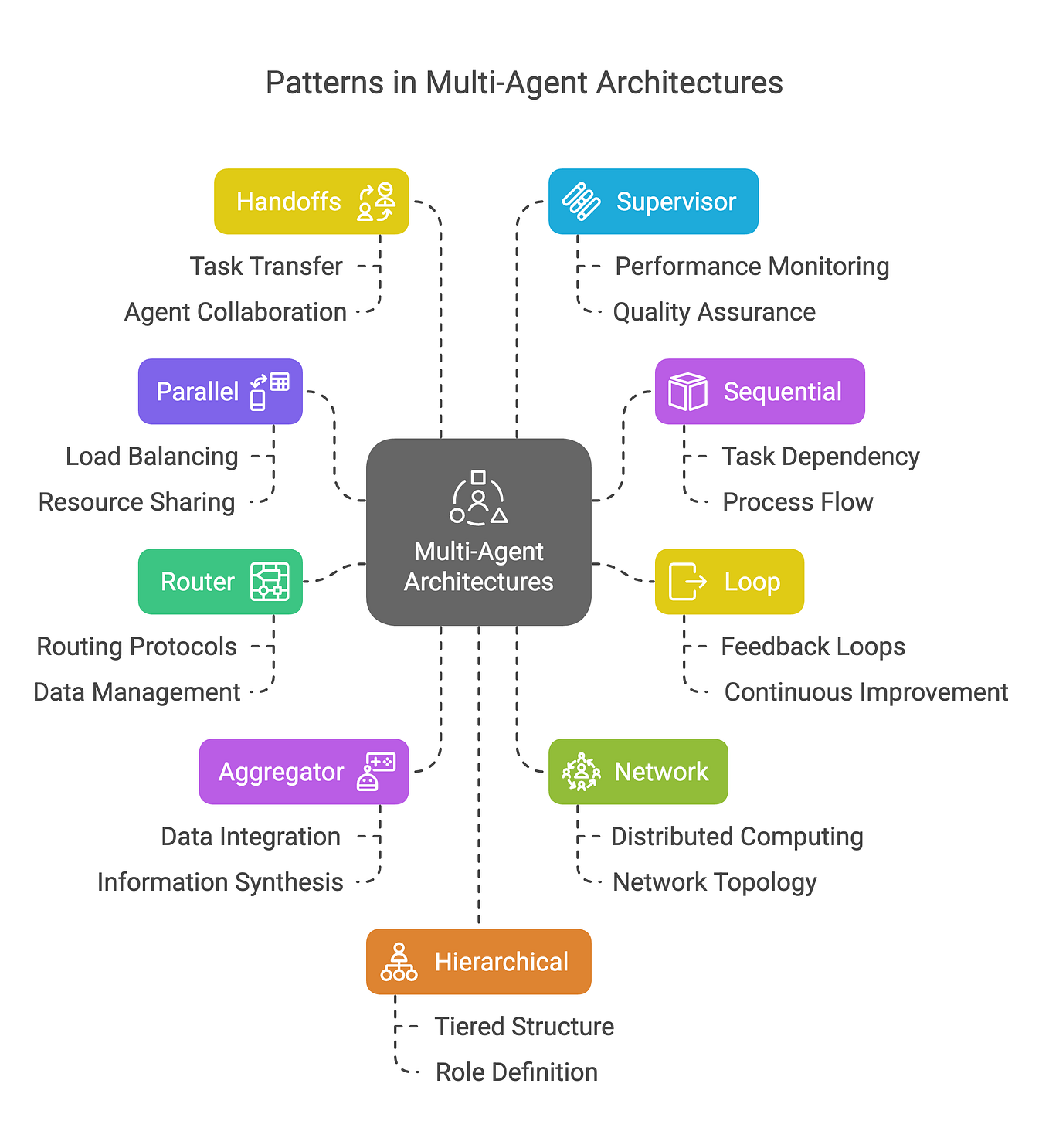
As Large Language Model (LLM) capabilities mature, engineering teams quickly hit the limits of single, monolithic AI agents. When you give one agent too many tools, systemic prompts, and responsibilities, its reliability drops. The context window clutters, the model loses focus, and execution fails. The natural evolution for complex workflow automation is separation of concerns: deploying multiple specialized agents that communicate, negotiate, and collaborate.
This is the agent-to-agent ecosystem, commonly referred to as Multi-Agent Systems (MAS). For CTOs, founders, and senior engineering leads, moving from single-agent pilots to multi-agent production systems requires a fundamental shift in architecture. You are no longer just tuning prompts. You are designing distributed systems where the computing nodes exhibit probabilistic, non-deterministic behavior.
This guide outlines the core mechanics of agent-to-agent systems, the prevailing architectural patterns, and the concrete trade-offs involved. By the end, you will understand how to structure agent communications, manage security risks, and choose the right deployment topology to ensure reliable delivery in your organization.
Core Mechanics of Agent-to-Agent Systems
In a traditional microservices architecture, services communicate via strict APIs, predictable payloads, and rigid state machines. In an agent ecosystem, communication is often semantic. Agents pass natural language messages, structured JSON, or tool-call definitions to one another.
To make this work in a production environment, you must standardize three core mechanics:
1. Communication Protocols
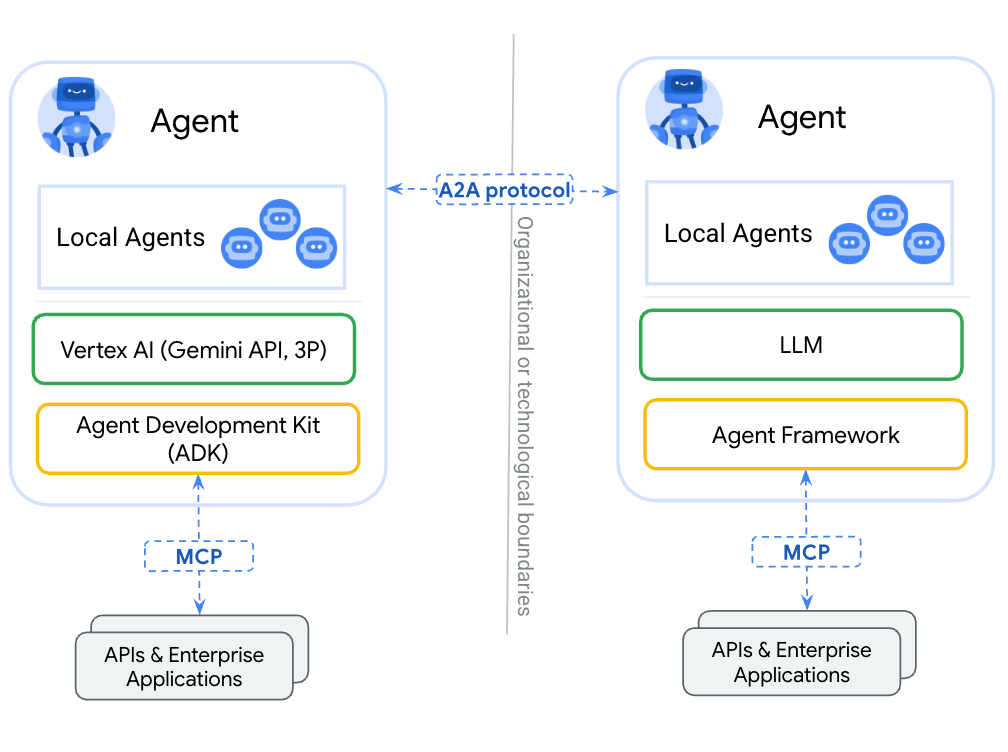
Agents need a defined medium to exchange information. This generally falls into two categories:
- Direct Message Passing: Agents invoke each other directly, similar to synchronous RPC calls. Agent A finishes a task and directly prompts Agent B with the output.
- Shared Context (Blackboard Pattern): Agents do not talk directly. Instead, they read from and write to a shared state or database (the "blackboard"). An orchestrator monitors this state and triggers the next agent when specific conditions are met.
2. State Management
Because LLMs are inherently stateless, the ecosystem must manage conversation history and execution state. Frameworks approach this differently. Some inject the entire multi-agent conversation history into every agent's context window. This is easy to build but scales poorly.
Practical implementation requires localized state: each agent only receives the specific data it needs to perform its isolated task, managed by a central graph or state machine.
3. Tool Execution and Handoffs
A critical mechanic is the "handoff." When an agent reaches the boundary of its capability, it must cleanly yield control. This requires strict output parsing, usually enforcing JSON schemas, so that the receiving agent gets structured data rather than conversational filler.
Architectural Patterns and Operating Models
The topology you choose dictates the system's scalability, latency, and observability. There are three primary patterns for agent-to-agent solution design.
The Sequential Pipeline (Chained Agents)
This is the simplest and most deterministic pattern. Agents operate in a Directed Acyclic Graph (DAG).
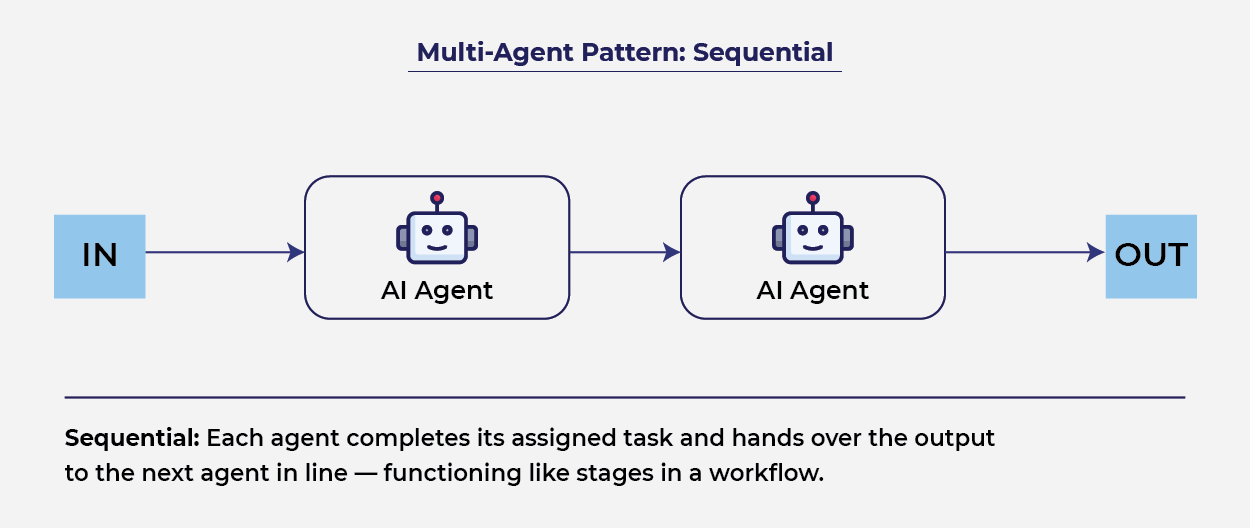
- How it works: Agent A (e.g., Researcher) gathers data and outputs a summary. Agent B (e.g., Analyst) ingests the summary and outputs a financial model. Agent C (e.g., Writer) drafts the final report.
- Trade-offs: Highly predictable and easy to trace. However, it lacks flexibility. If Agent B realizes Agent A missed critical data, a strict pipeline cannot easily loop back without complex error-handling logic.
- Best for: Linear workflow automation where tasks are well-understood and rarely require backward iteration.
The Hierarchical Supervisor
In this pattern, a primary "Supervisor" agent acts as a router. It receives the overarching task, decomposes it, and delegates sub-tasks to specialized "Worker" agents.
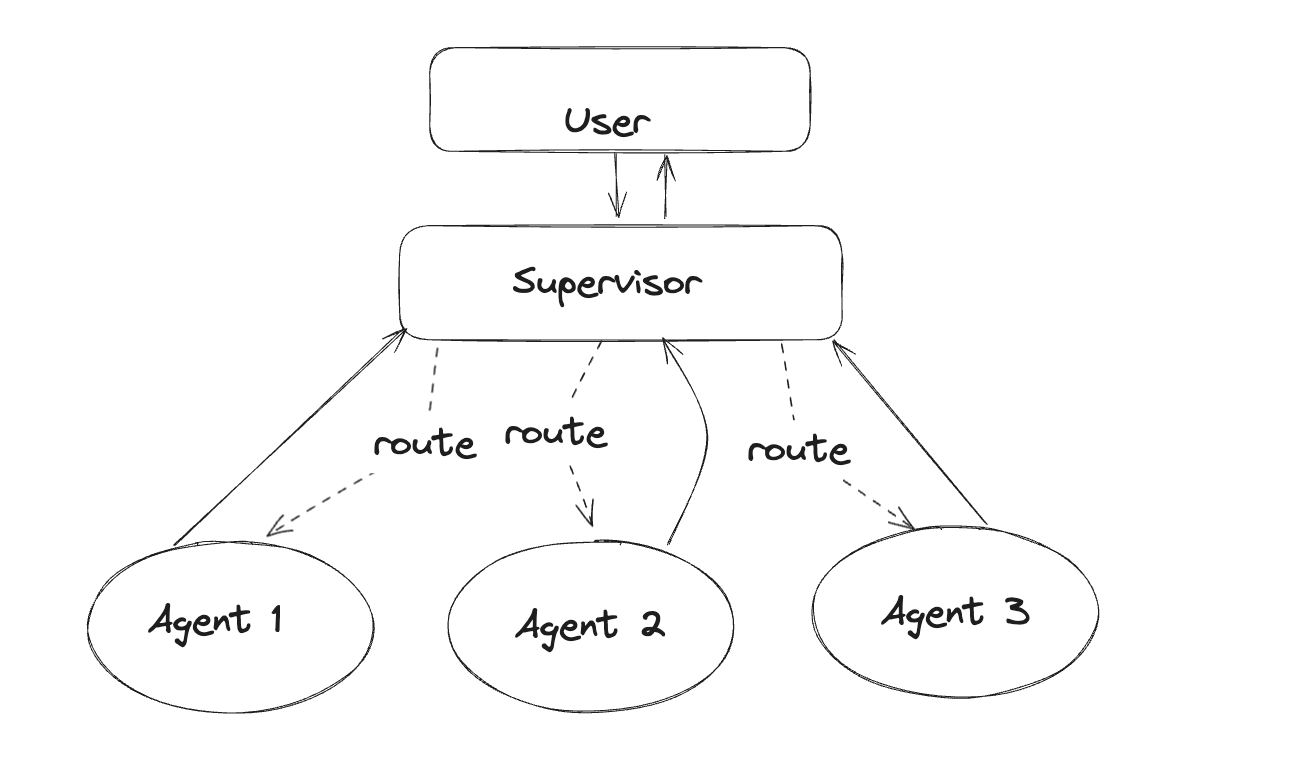
- How it works: The Supervisor reviews the user request, decides that the `SQL_Query_Agent` and the `Data_Visualization_Agent` are needed, invokes them in order, reviews their work, and compiles the final response.
- Trade-offs: Centralizes control and makes state management easier, aligning well with enterprise security boundaries. However, the Supervisor becomes a single point of failure and a latency bottleneck. If the Supervisor's prompt is too complex, it may route tasks incorrectly.
- Best for: Complex, multi-step operations where clear ownership of the final output must rest with a single orchestrator. Frameworks like LangGraph documentation excel at this structured, graph-based routing.
Peer-to-Peer Network (Choreography)
This is a fully decentralized model. Agents operate autonomously and broadcast messages to a group chat or message bus.
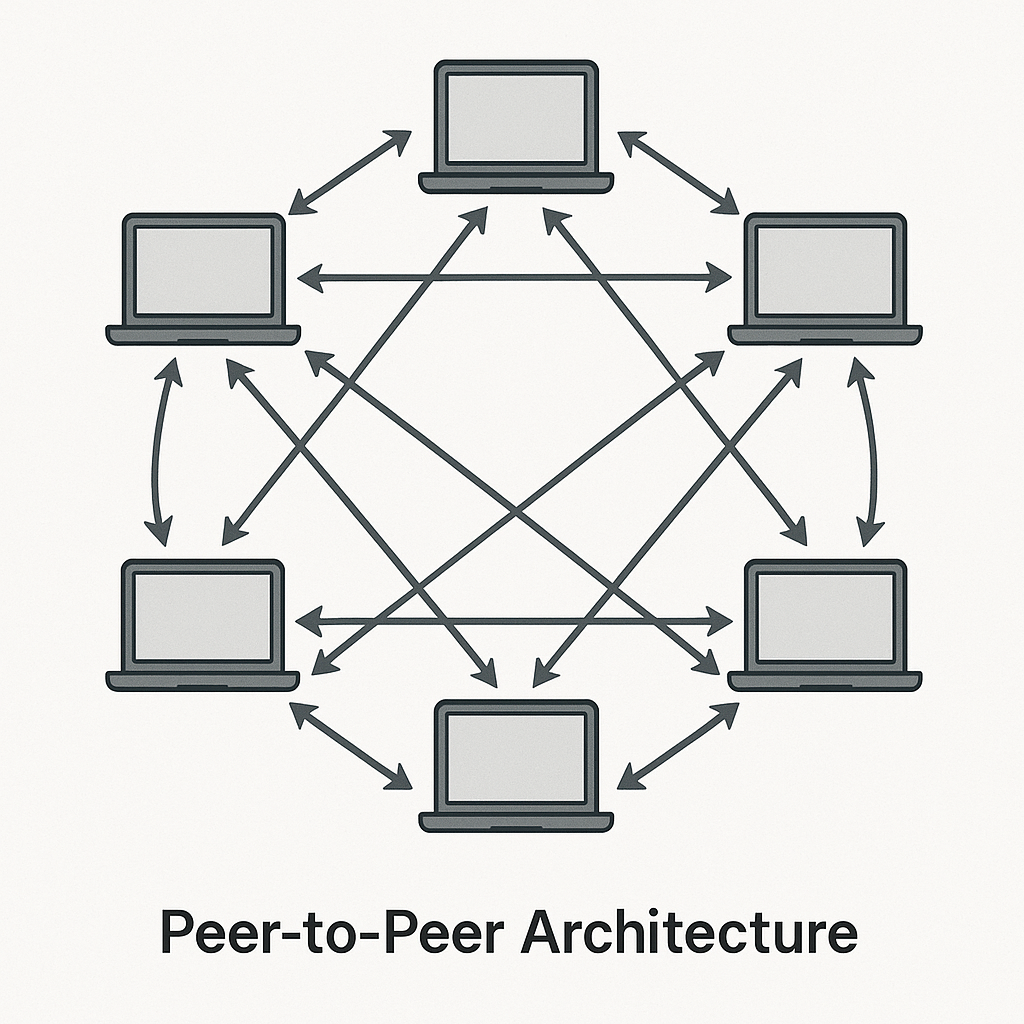
- How it works: A `Coding_Agent`, a `Testing_Agent`, and a `Reviewing_Agent` are placed in an environment. The coder writes code, the tester automatically picks it up and runs it, broadcasting errors back to the coder. They converse until the tests pass.
- Trade-offs: Highly adaptable and capable of solving ambiguous problems. However, it is chaotic. It is prone to infinite loops, massive token consumption, and debugging nightmares.
- Best for: R&D, open-ended problem solving, and highly autonomous AI agent implementation where rigid workflows fail. (Often demonstrated in platforms like Microsoft AutoGen reference).
Practical Use Cases
To evaluate fit, look at processes where human teams currently hand off specialized, context-heavy work.
- Automated Software Engineering: A product manager agent writes requirements, a lead engineer agent breaks them into tickets, a coder agent writes the software, and a QA agent writes the tests. If a test fails, the QA agent hands the error trace directly back to the coder agent.
- Financial Operations and Compliance: A data-gathering agent scrapes SEC filings. A distinct compliance agent reviews the extracted data against internal policies. A reporting agent formats the approved data into an internal memo. Separating the "gatherer" from the "compliance reviewer" prevents the AI from bending the rules to fulfill the data-gathering goal.
- Customer Support Triage: A lightweight, fast routing agent categorizes incoming tickets. Technical tickets are handed to an agent with access to code repositories and internal wikis, while billing tickets are handed to an agent securely integrated with Stripe or an ERP.
Trade-offs, Risks, and Constraints
Deploying an ecosystem of talking agents introduces unique distributed systems problems.
The Confused Deputy Problem (Security)
When agents talk to agents, security authorization becomes complex. Imagine a `Research_Agent` that reads public web pages, and an `Execution_Agent` that has access to your internal database.
If the `Research_Agent` reads a maliciously crafted web page (Prompt Injection), and then passes that poisoned instruction to the `Execution_Agent`, your internal database is at risk.
You must enforce strict permission boundaries. An agent should only assume the least privilege necessary, and inter-agent communication must be sanitized.
Cascading Latency
LLMs are slow. If a user request requires four agents to collaborate sequentially, and each agent takes 5 seconds to process and respond, the user is waiting 20 seconds. Agent-to-agent architectures are rarely suitable for synchronous, low-latency user interfaces. They belong in asynchronous, background-processed workflow automation.
Token Exhaustion and Infinite Loops
In peer-to-peer or loosely structured supervisor models, agents can get stuck in debate. The `Review_Agent` tells the `Drafting_Agent` to fix a paragraph. The `Drafting_Agent` fixes it, but introduces a new error. They loop endlessly. Because LLM APIs charge by the token, an infinite loop running overnight can result in severe cost overruns. Hard limits on iteration cycles (e.g., `max_turns=3`) are mandatory.
Observability and Tracing
When a single agent fails, you read the prompt and the output. When an ecosystem fails, you have to trace a web of non-deterministic API calls. You must implement distributed tracing specifically designed for LLMs to see exactly which agent hallucinated the data that poisoned the downstream workflow.
Concrete Decision Criteria
When designing your solution, use the following criteria to choose between a single agent, a sequential pipeline, or a hierarchical multi-agent system.

Rule of Thumb: Never start with a multi-agent system. Build a single agent first. When it begins failing because you have stuffed 15 tools and 3,000 words of instructions into its prompt, it is time to split it into a hierarchical or sequential multi-agent architecture.
Common Pitfalls and How to Avoid Them
Serious engineering teams treat multi-agent systems as software, not magic. Avoid these common traps:
- Treating agents like humans: Do not rely on implicit instructions like "talk to the other agent and figure it out." Define strict API contracts. Use JSON schema enforcement for all inter-agent handoffs. If Agent A sends data to Agent B, Agent B should expect a validated data object, not a conversational paragraph.
- Skipping Human-in-the-Loop (HITL): For high-stakes workflows (e.g., executing code, sending customer emails, modifying databases), the ecosystem must pause and wait for a human approval token before the final execution agent fires.
- Over-engineering early: Adopting complex peer-to-peer frameworks before mastering sequential pipelines leads to brittle systems. Start by orchestrating multiple agents using standard code (e.g., standard Python functions chaining LLM calls) before adopting heavy abstractions. You can explore standard infrastructure approaches via Google Cloud Vertex AI architecture to understand how underlying managed services support these patterns.
- Leaking global state: Do not pass the entire ecosystem's chat history to every agent. A specialized `SQL_Agent` does not need to know what the user and the `Greeting_Agent` discussed three turns ago. Pass only the narrow context required for the immediate task.
Takeaways
- Separate to scale: Use multi-agent ecosystems when a single agent becomes overloaded with tools and context. Separation of concerns improves reliability.
- Control the topology: Peer-to-peer agent networks are powerful but unpredictable. For enterprise reliability, default to Sequential Pipelines or Hierarchical Supervisors.
- Enforce strict boundaries: Inter-agent communication is a security boundary. Sanitize inputs between agents to prevent confused deputy attacks and prompt injection propagation.
- Plan for asynchrony: Multi-agent collaboration incurs compounding latency. Design user experiences around asynchronous delivery rather than real-time chat.
- Mandate strict handoffs: Ensure continuous improvement and stable execution by enforcing structured data (JSON) whenever one agent passes control to another.
Join the newsletter
Enjoyed this article? Get more like it in your inbox every week.
* 200+ tech professionals already in.
Next read
28 Jul 2026
5 Architectural Strategies to Unlock AI’s Full Potential
Move beyond prototype LLMs. Discover five architectural strategies to build reliable, grounded, and measurable AI systems that deliver real business value for the enterprise.
20 Jul 2026
Engineering an Agentic Workforce: Using Google Workspace
Examine how enterprises use Google Workspace and Vertex AI to shift from basic generative chat to secure, multi-step agentic workflows that drive measurable improvement.
13 Jul 2026
Responsible and Explainable AI: A Practical Guide for Engineering Leaders
Move beyond compliance. Learn how to architect AI systems that balance model performance with transparency, safety, and operational governance for reliable delivery.