27 Apr 2026
Architectural Routing: When to Use AI Agents vs. Traditional Software
 Reviewed byAzjargal Gankhuyag· AI Agent Engineer | Solution Architect
For technical leadership, choosing between AI agents and deterministic software is a fundamental architectural decision about control flow, scalability, and operational risk.
Framing the Control Flow Decision
For engineering leadership, the choice between traditional software and AI agents is not a debate between "old" and "new" technology. It is a fundamental architectural decision about control flow.
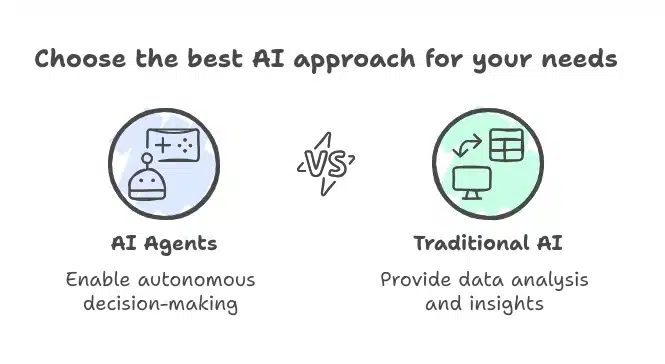
In traditional software, developers explicitly define the path of execution. Every edge case requires a rule. Every conditional branch is mapped. In agentic systems, developers define the goal and provide a set of tools, delegating the moment-to-moment control flow to a Large Language Model (LLM).
This distinction dictates how your team will build, test, and scale the system. Understanding when to rely on explicit logic and when to introduce autonomous reasoning determines whether you ship a reliable, cost-effective product or a brittle, unpredictable experiment. After reading this, you will understand the mechanical differences between these approaches, the specific operational trade-offs they require, and the concrete criteria for routing workloads to the right paradigm.
Core Mechanics: Rules vs. Reasoning
To make informed architectural decisions, you must look past the interface and understand how these systems process information.
The Deterministic Engine (Traditional Software)
Traditional software operates as a state machine. It relies on explicit inputs, structured data, and rigid conditional logic (if/then/else).
- Execution: The execution path is static and predictable. If A happens, B follows.
- Failure mode: Failures are explicit. If the system encounters an undefined state, it throws an exception or crashes.
- Optimization: You optimize by profiling code, caching responses, and reducing algorithmic complexity.

The Probabilistic Engine (AI Agents)
An AI agent is an architectural pattern where an LLM acts as the reasoning engine to drive a workflow. Instead of following a hard-coded path, the agent uses a framework like the ReAct paradigm (Reason + Act) to observe an input, decide which tool to use, evaluate the output of that tool, and decide if the overall goal has been met.
- Execution: The execution path is dynamic. The agent might take two steps to solve a problem today and four steps to solve the exact same problem tomorrow if the context slightly changes.
- Failure mode: Failures are often silent or behavioral. The agent might get stuck in an infinite loop, hallucinate a tool response, or confidently return an incorrect answer.
- Optimization: You optimize by refining prompts, improving tool descriptions, and managing the context window.
Architectural Patterns and Operating Models
Modern systems rarely rely entirely on one paradigm. Practical implementation usually involves combining deterministic constraints with agentic capabilities.
Pattern 1: The Deterministic Core (Traditional)
This is standard software engineering. A web application handles user requests, reads from a database, performs business logic, and returns a view. The control flow is 100% predictable. You use this for transactional systems, financial ledgers, and any process where the cost of a single error is unacceptably high.
Pattern 2: LLM as a Feature (Hybrid)
In this model, the control flow remains entirely traditional, but the application calls an LLM to process a specific, isolated task. For example, a standard script pulls recent customer support tickets and sends them to an LLM for summarization, then saves the summary to a database. The LLM does not decide what happens next; it only transforms data.
Pattern 3: The Agentic Workflow (Agent-Driven)
Here, the LLM takes the steering wheel. A user asks a complex question. The agent decides to query an internal database, reads the result, realizes the data is incomplete, decides to call a third-party search API, synthesizes the combined data, and returns the answer. Tools like Vertex AI Reasoning Engine facilitate this pattern by providing a managed environment for tool calling and state management.
Pattern 4: Multi-Agent Systems
Instead of one monolithic agent trying to handle all tools and rules, the workload is distributed among specialized agents. A "Router Agent" evaluates an incoming request and hands it off to either a "Data Analysis Agent" or a "Customer Communication Agent." This pattern restricts the context window and tool set for each specific agent, improving reliability.
Evaluating Use Case Fit
Matching the business problem to the correct paradigm requires looking at the nature of the inputs and the strictness of the required outputs.
When Traditional Software Wins
Traditional software is the correct choice when inputs are highly structured and the process requires absolute precision.
- Payment Processing: Calculating tax, applying discounts, and settling transactions requires zero variance.
- High-Frequency Trading: Decisions must be executed in microseconds based on explicit mathematical models.
- Compliance Reporting: Generating regulatory filings where every field must map exactly to a specific database schema.
When AI Agents Win
AI agents excel when dealing with ambiguity, unstructured data, and open-ended workflows that would require an impossible number of "if/else" statements to capture.
- Unstructured Data Triage: Processing hundreds of vendor invoices, each in a different format, extracting the relevant line items, and mapping them to a standard internal schema. A traditional parser breaks when a vendor changes their PDF layout; an agent adapts.
- Research and Synthesis: An analyst needs to compile a dossier on a competitor by reviewing recent SEC filings, news articles, and internal CRM notes. An agent can autonomously navigate these distinct data sources, query them iteratively, and summarize the findings.
- Dynamic Customer Support: Resolving a customer issue that might require checking a shipping API, looking up a warranty policy in a PDF, and updating a billing record.
Trade-offs, Risks, and Constraints
Delegating control flow to a language model introduces serious operational realities. You must evaluate these constraints before choosing an agentic architecture.
Latency
Traditional software executes logic in milliseconds. AI agents require sequential network calls to an LLM provider. If an agent needs to reason, call a tool, reason about the output, and call another tool, the total response time can easily stretch into tens of seconds. If your user experience demands real-time, sub-second responses, an autonomous agent will fail the requirement.
Operational Cost
Running a deterministic script costs fractions of a cent in compute. Agentic workflows require sending large chunks of text (context) back and forth to an LLM. While inference costs are dropping, a multi-step agentic workflow processing high volumes of data can quickly become expensive. You must weigh the cost of compute against the cost of human labor the agent replaces.
Reliability and Security
Deterministic systems fail predictably. You can write unit tests that guarantee specific outcomes. Agents are non-deterministic. A change in the LLM's underlying model weights, or a slight variation in the user's prompt, can alter the agent's behavior.
Security is also vastly different. If an agent has access to a "delete_record" tool and a "send_email" tool, you must account for prompt injection. A malicious user might attempt to instruct the agent to delete the database. Traditional role-based access control (RBAC) must be rigidly enforced at the tool level, not just the interface level.
The Testing Paradigm
You cannot effectively unit test an AI agent using traditional assertions. Because the output varies, engineering teams must invest in LLM evaluations (Evals). This involves building datasets of hundreds of test scenarios and using automated scoring (often using another LLM as a judge) to ensure the agent's accuracy and behavior remain within acceptable bounds. If your team is not prepared to build an evaluation pipeline, you are not ready to deploy an agent to production.
Concrete Decision Criteria
When evaluating a new feature or internal workflow, use these criteria to decide which architecture to pursue.
Choose Traditional Software when:
- Input variability: Low. Inputs are structured (JSON, standardized forms, database rows).
- Output tolerance: Zero. The answer must be mathematically or logically perfect every time.
- Latency requirement: Strict. Responses must be delivered in milliseconds.
- Execution complexity: Predictable. The workflow can be comprehensively mapped on a flowchart.
Choose an AI Agent when:
- Input variability: High. Inputs are unstructured (emails, PDFs, conversational text, variable schemas).
- Output tolerance: Flexible. "Good enough" synthesis or human-in-the-loop review is acceptable.
- Latency requirement: Lenient. Users or asynchronous processes can wait seconds or minutes for completion.
- Execution complexity: Ambiguous. The steps to solve the problem depend heavily on the context of the specific request.
Common Pitfalls in Agent Implementation
Teams moving from deterministic engineering to agentic workflows frequently encounter the same failures. Avoiding these pitfalls requires discipline.
- The "God Agent" Fallacy: Teams often try to build a single agent with a massive system prompt and access to 30 different tools. The LLM's attention degrades, it gets confused about which tool to use, and reliability plummets. Solution: Scope agents narrowly. Give them a specific job and 3-5 well-defined tools.
- Skipping Observability: If an agent fails to complete a task, you need to know *why*. If you only log the final output, you are flying blind. Solution: Implement tracing for agentic workflows. You must log the full prompt, the agent's reasoning steps, the exact payload sent to tools, and the tool responses.
- Under-engineering the Tools: An agent is only as reliable as the tools it can access. If an internal search API returns messy, undocumented data, the agent will hallucinate trying to interpret it. Solution: Treat agent tools as top-tier internal products. Build clean, descriptive APIs with strict schemas specifically designed for LLM consumption.
- Ignoring the Human in the Loop: Deploying an agent to autonomously execute destructive actions (sending external emails, dropping tables, issuing refunds) without an initial period of human oversight is reckless. Solution: Design the workflow so the agent drafts the action and pauses for a human to click "Approve" until the evaluation metrics prove sustained reliability.
Takeaways for Practical Implementation
- Control flow defines the system. Use explicit logic for predictable tasks; use agentic reasoning when the system must navigate ambiguity.
- Agents are slow and compute heavy. Never use an agent for a task that a simple regex script or SQL query can accomplish reliably.
- Enforce security at the tool level. Never trust the agent's reasoning as a security boundary. Tools must explicitly enforce user permissions before executing an action.
- Invest in evaluation datasets. Non-deterministic systems require statistical testing. If you cannot measure an agent's success rate across a baseline dataset, you cannot safely iterate on its design.
- Start with hybrid architectures. The most successful practical implementations wrap LLM capabilities inside rigid, deterministic orchestrators. Let traditional software manage the critical paths, and deploy agents to handle the messy edges.
Join the newsletter
Enjoyed this article? Get more like it in your inbox every week.
* 200+ tech professionals already in.
Next read
28 Jul 2026
5 Architectural Strategies to Unlock AI’s Full Potential
Move beyond prototype LLMs. Discover five architectural strategies to build reliable, grounded, and measurable AI systems that deliver real business value for the enterprise.
20 Jul 2026
Engineering an Agentic Workforce: Using Google Workspace
Examine how enterprises use Google Workspace and Vertex AI to shift from basic generative chat to secure, multi-step agentic workflows that drive measurable improvement.
13 Jul 2026
Responsible and Explainable AI: A Practical Guide for Engineering Leaders
Move beyond compliance. Learn how to architect AI systems that balance model performance with transparency, safety, and operational governance for reliable delivery.