13 May 2026
Architecting the Agentic Data Cloud: Moving from Passive Queries to Active Workflows on GCP
 Reviewed byAzjargal Gankhuyag· AI Agent Engineer | Solution Architect
Google Cloud's Agentic Data Cloud shifts AI from passive generation to autonomous action. Learn how to architect data-driven agents, manage trade-offs, and govern execution.
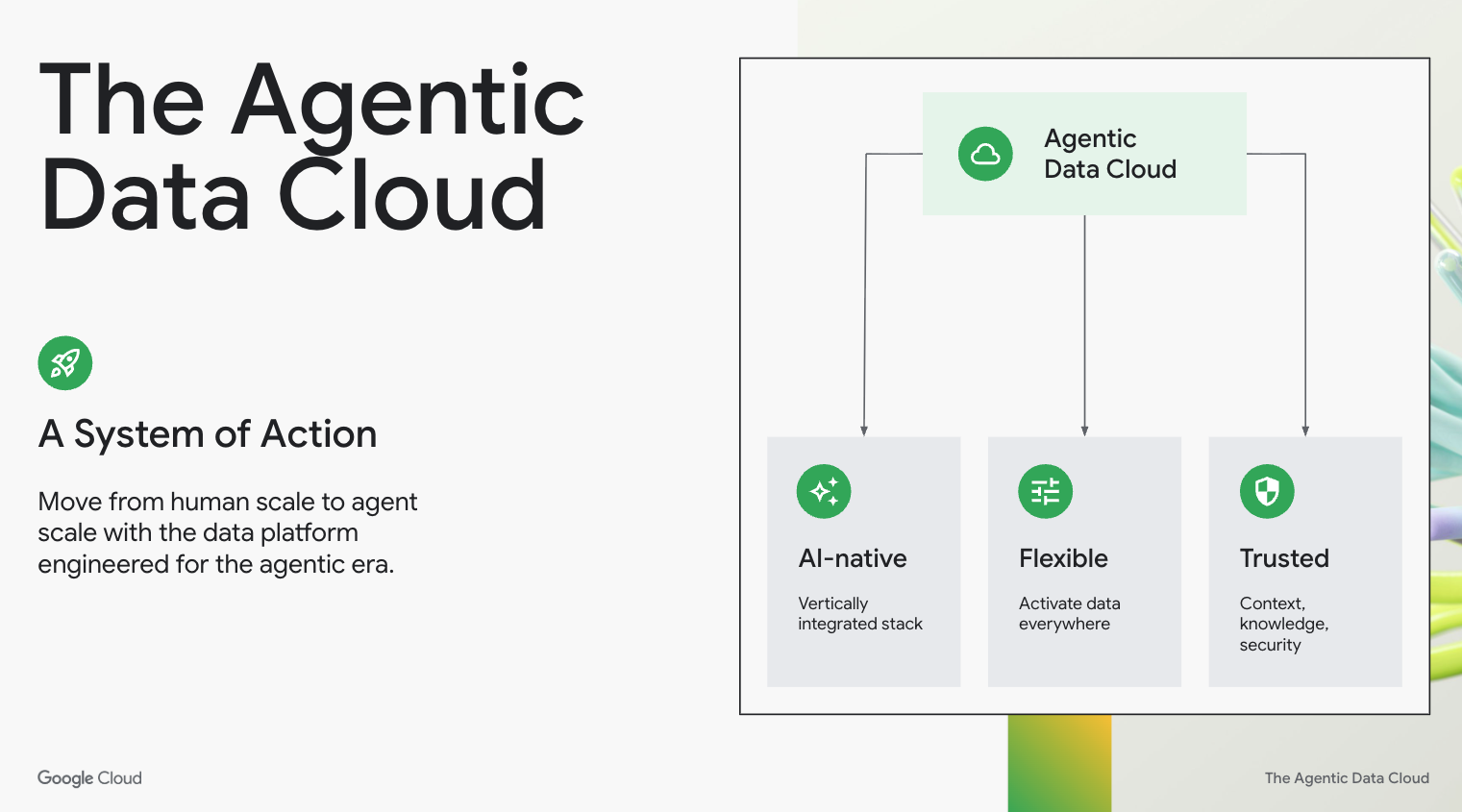
The Agentic Data Cloud: Moving from Passive RAG to Active Workflows
For the past two years, engineering teams have focused on connecting large language models to static enterprise data, primarily through Retrieval-Augmented Generation (RAG). While effective for document summarization and basic Q&A, standard RAG architectures are fundamentally passive. They retrieve text, but they cannot reason about live structured data, execute multi-step workflows, or take actions in external systems.
Google Cloud’s introduction of the Agentic Data Cloud represents a structural shift to solve this limitation. It is not a single new product SKU, but rather an architectural convergence of Google’s data foundations (BigQuery, Spanner, AlloyDB) with its reasoning engines (Gemini, Vertex AI Agent Builder). The goal is to enable AI agents to securely query schemas, write SQL, analyze results, and trigger downstream APIs to automate complex workflows.
For CTOs and senior engineering leads, this shift forces a re-evaluation of how software interacts with data. The decision is no longer just how to store and serve data, but how to expose that data safely to autonomous reasoning engines. By understanding the mechanics of the Agentic Data Cloud, engineering teams can transition from building fragile, point-to-point data integrations to designing robust AI agent implementations that drive measurable improvement in business operations.
What Readers Will Understand
- The mechanics of how agents securely interface with Google Cloud data services.
- The core architectural patterns for building data-aware workflow automation.
- The trade-offs between latency, accuracy, and cost when using autonomous agents.
- Concrete criteria for deciding when to adopt an agentic approach versus traditional data pipelines.
Core Mechanics: How Agents Interact with GCP Data Services
At the center of the Agentic Data Cloud is the concept of tool use, or function calling. Instead of simply generating text, a model like Gemini Pro is provided with a set of tools—APIs, BigQuery interfaces, or custom Python functions.
The process relies on a reasoning loop, often built using Vertex AI Agent Builder or orchestration frameworks like LangChain deployed on Google Cloud infrastructure. When a user or system submits a complex prompt, the agent:
- Parses the intent and identifies which data sources are required.
- Selects the appropriate tool, such as a BigQuery query engine or a Spanner API.
- Generates the structured request (e.g., writing a SQL query based on a provided schema).
- Executes the request securely against the data platform.
- Analyzes the output, deciding if the answer is complete or if subsequent queries are needed to resolve errors or gather more context.
This is made possible by deep integrations within the GCP ecosystem. BigQuery now supports native vector search and embedding generation, meaning agents can execute hybrid queries that combine semantic similarity with traditional structured filters (e.g., "Find all log errors matching this stack trace from customers who generate over $50k in ARR"). Furthermore, the massive context window of the latest Gemini models allows developers to feed entire database schemas, API documentation, and business rules directly into the agent's working memory, reducing the hallucination of table names or column definitions.
Architectural Patterns for Data-Driven Agents
Implementing an agentic architecture requires clear boundaries. Exposing a raw, underlying database to an LLM is a recipe for broken queries and security risks. Serious teams adopt specific patterns to mediate how agents access data.
Pattern 1: The Semantic Layer Agent (Read-Only)
In this pattern, the AI agent does not write raw SQL against operational databases. Instead, it interacts with a highly curated semantic layer or a set of predefined parameterized queries.
- How it works: The agent translates user intent into API calls against tools like Looker or custom internal APIs that serve aggregated BigQuery data.
- When to use it: For executive dashboards, financial reporting, and external customer-facing chatbots where data accuracy is critical and hallucinated SQL cannot be tolerated.
Pattern 2: The Operational Workflow Agent (Read-Write)
This pattern involves agents that not only read data but execute state changes.
- How it works: The agent uses read tools to assess the current state (e.g., querying Cloud SQL for an order status) and write tools to trigger actions (e.g., calling a REST API to issue a refund or update a CRM record).
- When to use it: Internal workflow automation, such as IT helpdesk resolution, dynamic supply chain routing, or automated pipeline triage. This requires strict human-in-the-loop approvals for sensitive write actions.
Pattern 3: Hybrid RAG and Structured Reasoning
The most advanced pattern combines unstructured document retrieval with structured data analysis.
- How it works: An agent receives a request, searches a vector database for relevant unstructured policies (PDFs, docs), and simultaneously queries BigQuery for the mathematical or historical data needed to apply that policy.
- When to use it: Complex underwriting, claims processing, or compliance auditing where both qualitative rules and quantitative data must be evaluated together.
Practical Use Cases for Engineering Teams
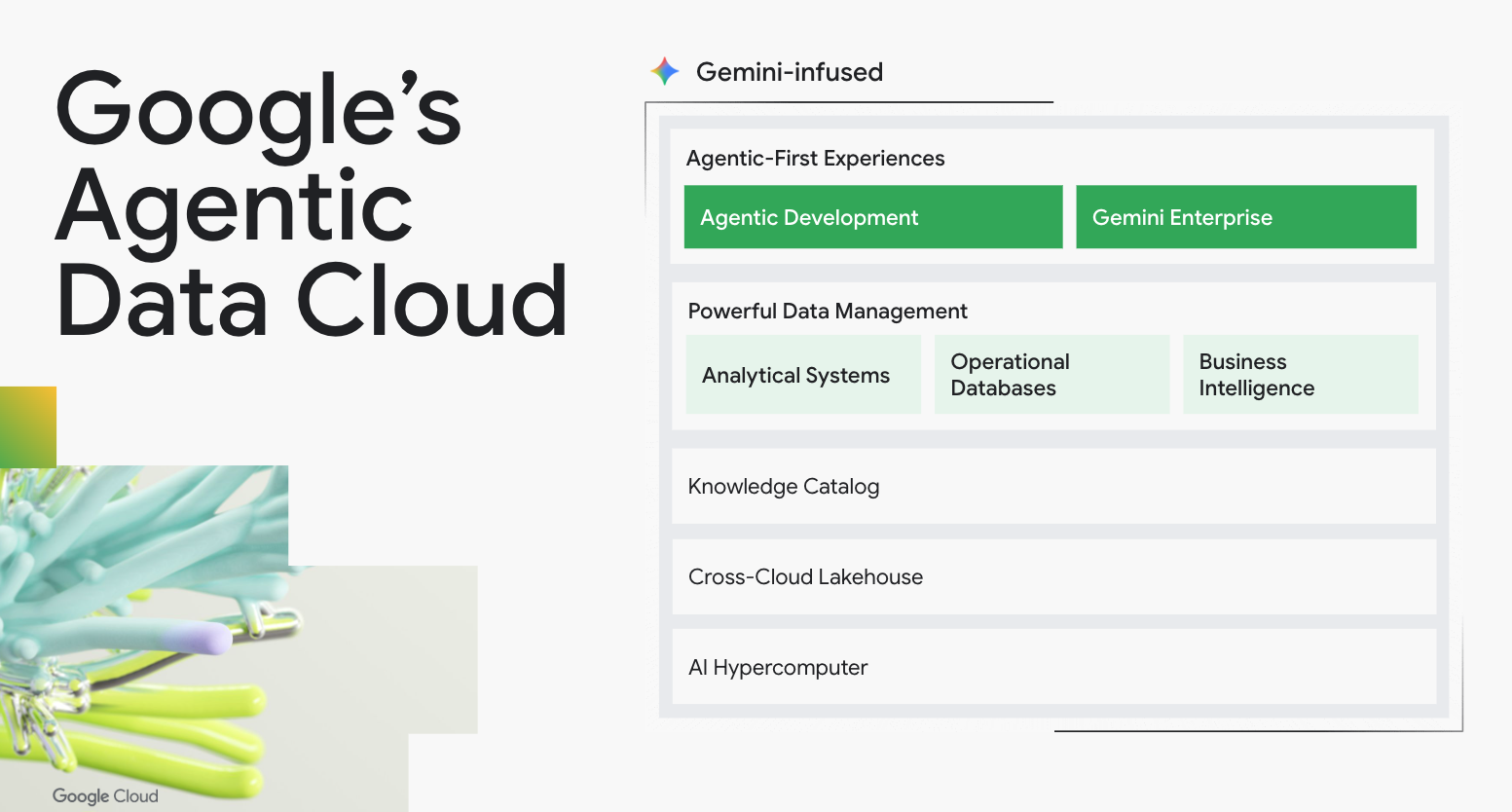
Moving beyond theoretical architectures, the Agentic Data Cloud provides clear value in specific operational domains.
- Automated Data Pipeline Triage: Data engineers spend hours diagnosing failed database runs or Airflow DAGs. An agent with access to BigQuery execution logs, GitHub repositories, and incident history can automatically analyze a failure, query the exact rows that caused a schema mismatch, and draft a pull request to fix the pipeline.
- Dynamic Financial Reconciliation: Instead of static reconciliation scripts that break when vendor formats change, agents can dynamically map incoming CSV columns to standard database schemas, query historical anomaly patterns in AlloyDB, and flag discrepancies for human review with a plain-text explanation of the variance.
- Customer 360-Degree Workflow Automation: Support agents are often bottlenecked by navigating multiple systems. A data-aware agent can query a customer's usage telemetry in BigQuery, their billing history in Stripe, and their support tickets in Zendesk, synthesizing the data to automatically grant a service extension or suggest a highly specific technical fix.
Trade-offs, Risks, and Constraints
Adopting an Agentic Data Cloud architecture introduces new complexities that engineering leadership must carefully manage. Autonomous systems do not behave like deterministic code.
Latency vs. Autonomy
Agentic loops take time. Every time an agent decides to use a tool, writes a query, waits for the BigQuery response, and reads the result, it incurs round-trip latency and LLM generation time. A complex multi-step reasoning loop can take 15 to 30 seconds. If your use case requires real-time, sub-second responses, an autonomous agent writing dynamic queries on the fly will fail. You must validate latency tolerances before committing to an agentic design.
Hallucinated Queries and Schema Drift
When agents are tasked with generating SQL or API payloads dynamically, they will inevitably make mistakes. If a database schema changes (e.g., a column is renamed) and the agent's context is not updated, the queries will fail. Building self-correcting loops—where the agent reads the SQL error and tries again—mitigates this, but increases latency and token costs.
Security, IAM, and Governance
The most significant risk in the Agentic Data Cloud is identity management. When an agent queries BigQuery, who is executing the query? If the agent uses a single, highly privileged service account, you risk cross-tenant data exposure. Teams must implement strict row-level security in BigQuery and utilize OAuth user impersonation so the agent only accesses data the requesting user is authorized to see. Relying solely on the LLM's system prompt to enforce security boundaries is fundamentally insecure; governance must be enforced at the data layer.
Concrete Decision Criteria
Not every problem requires an AI agent. Use the following criteria to evaluate whether to build a deterministic pipeline or adopt an Agentic Data Cloud approach.
Choose Deterministic Data Pipelines When:
- The inputs and required outputs are highly predictable.
- Sub-second latency is a hard requirement.
- Regulatory compliance demands 100% trace-ability of the execution path.
- The task involves moving massive volumes of data (ETL/ELT) rather than reasoning about it.
Choose Agentic Data Architectures When:
- The workflow requires interpreting unstructured intent alongside structured data.
- The system must handle edge cases that break rigid programmatic rules.
- The goal is workflow automation across disparate systems with varying API structures.
- You want to empower non-technical users to ask complex, ad-hoc questions without requiring data engineers to build custom dashboards.
Common Pitfalls and How Serious Teams Avoid Them
Practical implementation of AI agents often reveals friction points that proof-of-concept demos gloss over. Avoiding these common pitfalls ensures reliable delivery.
- Exposing Raw Tables Without Context: Pointing an agent at a raw data warehouse without metadata is guaranteed to produce poor results. Successful teams build an intermediate abstraction—providing the agent with detailed data dictionaries, clear column descriptions, and examples of complex joins within the prompt context.
- Ignoring Cost Controls: Autonomous loops can result in massive cloud bills if an agent gets stuck in an infinite retry loop, continuously generating tokens and executing expensive BigQuery operations. Teams must implement hard caps on execution steps (e.g., max 5 iterations per request) and monitor BigQuery slot consumption generated by service accounts tied to agents.
- Skipping Evals in CI/CD: You cannot test an agentic workflow with simple unit tests. Because the SQL generation is non-deterministic, teams must implement LLM evaluation frameworks. This involves running automated tests against a golden dataset of questions to measure accuracy, query validity, and hallucination rates before deploying changes to production.
- Over-engineering the Agent: Don't ask an LLM to do basic math or aggregations if the database can do it faster and more accurately. The model should orchestrate the query; BigQuery should perform the heavy lifting. Push computational logic down to the data layer whenever possible.
Takeaways
- Shift from Retrieval to Execution: The Agentic Data Cloud moves AI from simply reading documents to actively querying structured data, triggering APIs, and executing workflow automation directly on Google Cloud.
- Enforce Security at the Data Layer: Never rely on LLM prompts for data governance. Implement row-level and column-level security in BigQuery, and enforce user impersonation for agent data access.
- Manage the Latency Trade-off: Autonomous reasoning loops take time. Reserve agentic architectures for asynchronous workflows or internal tools where users can tolerate multi-second response times in exchange for high-value insights.
- Provide Context, Not Just Access: Agents require well-documented schemas, semantic layers, and guardrails to generate accurate SQL. Curating the data metadata is as important as the data itself.
- Implement Hard Execution Limits: Protect your cloud infrastructure from infinite reasoning loops by capping agent iterations and strictly monitoring associated compute and token costs.
For further read, continue on the official Google Cloud’s blog.
Join the newsletter
Enjoyed this article? Get more like it in your inbox every week.
* 200+ tech professionals already in.
Next read
28 Jul 2026
5 Architectural Strategies to Unlock AI’s Full Potential
Move beyond prototype LLMs. Discover five architectural strategies to build reliable, grounded, and measurable AI systems that deliver real business value for the enterprise.
20 Jul 2026
Engineering an Agentic Workforce: Using Google Workspace
Examine how enterprises use Google Workspace and Vertex AI to shift from basic generative chat to secure, multi-step agentic workflows that drive measurable improvement.
13 Jul 2026
Responsible and Explainable AI: A Practical Guide for Engineering Leaders
Move beyond compliance. Learn how to architect AI systems that balance model performance with transparency, safety, and operational governance for reliable delivery.